




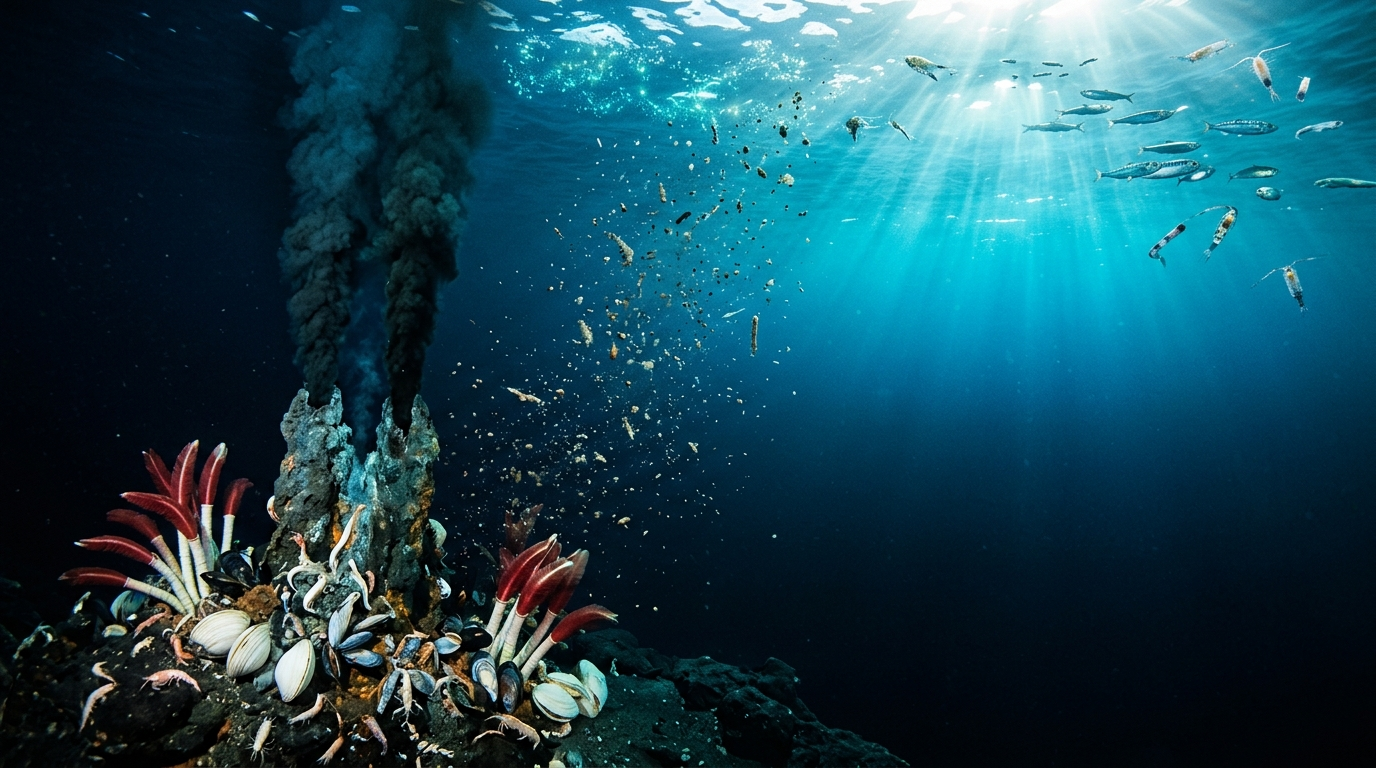
A new finding indicates that life can spread between isolated deep-sea vents, while remaining closely tied to the sunlit ocean far above.
The result challenges the view of vent ecosystems as fully separate biological islands. It suggests that distance and darkness do not cut them off from broader ocean life.
“The finding shows how life spreads between isolated deep-sea vents, and how closely those ecosystems are tied to the sunlit ocean.”
Details about the researchers, study site, species, and publication date were not provided. Even so, the central conclusion raises important questions about how deep-sea populations travel, survive, and recover.
Life Between Isolated Vents
Deep-sea vents form where heated, mineral-rich water flows from the ocean floor. They can support dense communities despite darkness and extreme pressure.
Each vent may be separated from the next by long stretches of seafloor. That distance creates a major problem for species that must find new habitat.
The finding indicates that life moves between these isolated sites. Such movement could involve larvae or other early life stages carried by ocean currents.
However, the available information does not identify the transport route or organisms involved. It also does not show how often successful movement occurs.
Those limits matter. Evidence that one species can reach another vent would not prove that every vent animal uses the same method.


A Connection to Surface Waters
The reported link to the sunlit ocean adds another layer to the discovery. Surface waters receive sunlight and support photosynthesis, which feeds much of the ocean’s food system.
Vent communities are often associated with chemosynthesis. In that process, microbes use chemicals from the Earth rather than sunlight to produce energy.
Yet chemical energy at vents does not mean these communities exist in complete isolation. Their life cycles, food supplies, predators, or dispersal routes may connect them to upper waters.
The finding points to several possible forms of connection:
- Young organisms may rise into currents before settling at another vent.
- Organic material from surface waters may sink and supply food.
- Changes near the surface may affect deep-ocean circulation and transport.
These are possible explanations, not confirmed mechanisms in the limited account of the research. Further evidence would be needed to determine which links were observed directly.
Why the Finding Matters
Understanding movement between vents can help scientists judge how resilient these ecosystems are. A damaged site may recover more easily if organisms regularly arrive from other vents.
Conversely, rare or unreliable movement could leave individual communities at greater risk. Local losses might persist if larvae cannot cross the gaps between suitable habitats.
The surface connection also means environmental pressures may travel through the ocean in unexpected ways. Shifts in temperature, currents, oxygen, or food production could affect life far below.
The finding therefore presents deep-sea vents as connected parts of a larger ocean system. Future research will need to identify the species involved, track their movement, and measure how strongly surface conditions shape vent life.
Those answers could influence conservation decisions, especially where human activity may disturb the seabed. The key takeaway is clear: even remote vents may depend on distant neighbors and events near the ocean’s surface.